Children's Hearing
Newborn Hearing Screening & Your Child's Hearing
Why early identification matters — and why hearing should continue to be monitored as children grow
Hearing is fundamental to how children learn to communicate, develop language, and engage with the world around them. The early years are a critical period for speech and language development, and hearing plays a central role in that process.
In Scotland, all newborn babies are offered a hearing screen shortly after birth. This is an important first step — but it is just that: a first step. Children's hearing can change as they grow, and a clear newborn screen does not mean that hearing difficulties cannot develop later in childhood.
Newborn hearing screening in Scotland
The Newborn Hearing Screening Programme (NHSP) offers all babies a hearing screen shortly after birth, usually before they leave the maternity unit or within the first few weeks of life. The aim is to identify babies who may have a permanent hearing loss as early as possible, so that appropriate support can be put in place during the critical early years of development.
The screening is quick, non-invasive, and can usually be completed while your baby is settled or asleep. It does not require your baby to respond or cooperate in any way.
Two methods may be used within newborn hearing screening programmes: Automated Otoacoustic Emissions (AOAE) and Automated Auditory Brainstem Response (AABR). The method used, and the pathway followed, can vary depending on the maternity unit and the individual baby's circumstances.
What are Automated Otoacoustic Emissions (AOAE)?
AOAE testing involves placing a small, soft probe in the outer part of your baby's ear. The probe plays quiet sounds and measures the response produced by the inner ear (the cochlea). When the cochlea is working normally, it produces a faint echo in response to sound — this is called an otoacoustic emission.
If the cochlea is responding as expected, the test records a clear response. If no clear response is detected, this does not necessarily mean your baby has a hearing loss — there are several reasons why a clear response may not be obtained, including fluid in the ear canal or movement during the test.
AOAE is often used as the first stage of newborn hearing screening. If a clear response is not obtained, further testing — including AABR — may be offered.
What is AABR?
Automated Auditory Brainstem Response (AABR) testing measures how the hearing nerve and brain respond to sound. It provides information about the pathway from the inner ear to the brainstem, and is used within newborn hearing screening when AOAE does not give a clear result, or as the primary screening method in some settings.
During AABR, small sensors (electrodes) are placed on your baby's head and neck, and soft earphones are placed over the ears. Quiet clicking sounds are played through the earphones, and the sensors detect the brain's response to those sounds. The test is completely non-invasive and painless.
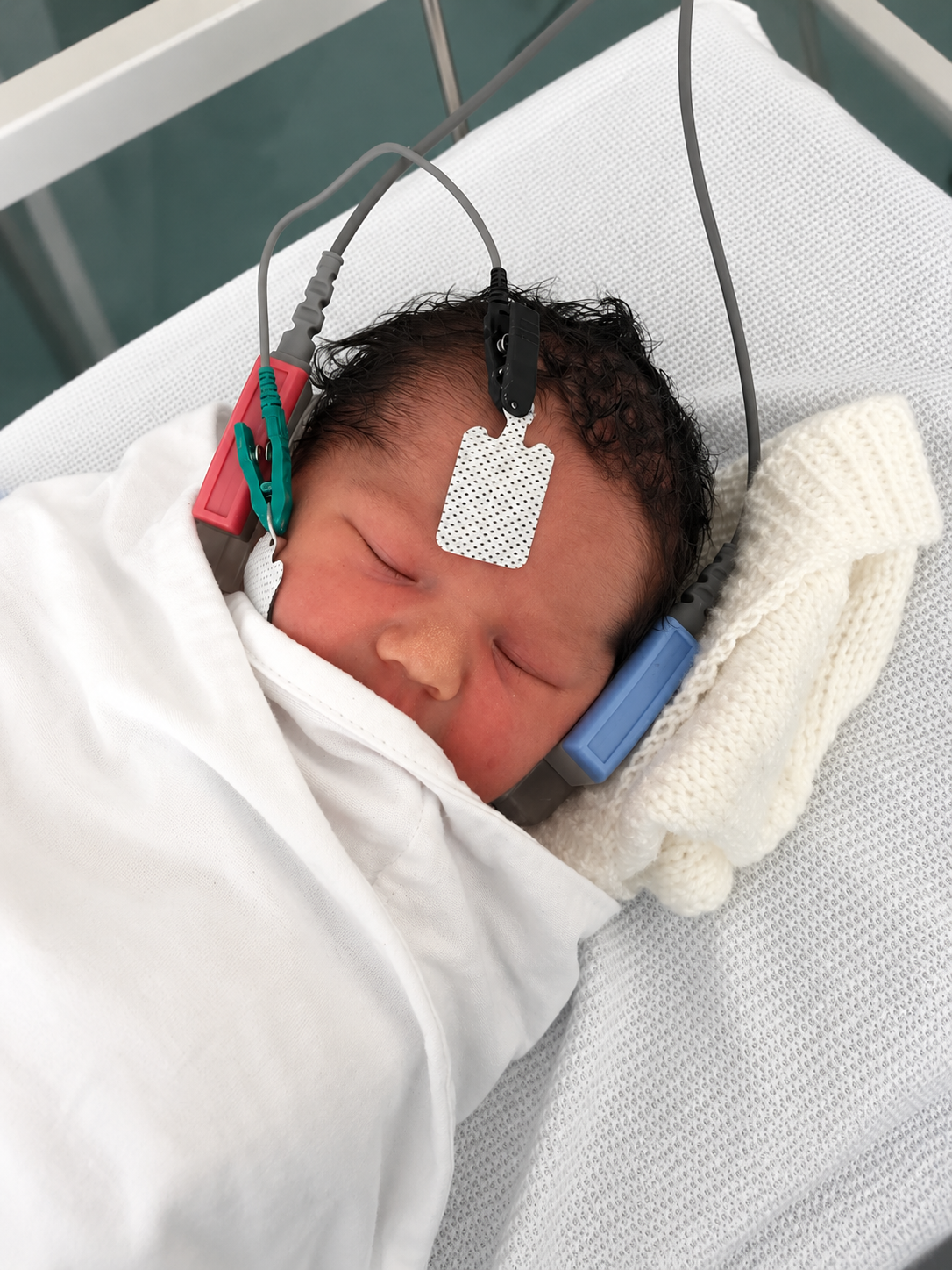
Like AOAE, AABR can usually be completed while your baby is settled or asleep. It does not require any response from your baby.
It is important to note that newborn hearing screening methods and pathways are not identical throughout the UK. The specific approach used will depend on your maternity unit and your baby's individual circumstances. If you are unsure which type of screening your baby received, your midwife or health visitor will be able to advise.
What does a clear newborn hearing screen mean?
A clear result means that your baby's hearing responded as expected at the time of the screen. This is reassuring news, and for most babies, it means that a significant permanent hearing loss is unlikely.
However, a clear newborn hearing screen is a screening test, not a diagnostic hearing assessment. It is designed to identify babies who may have a permanent hearing loss at birth — it cannot detect every type of hearing difficulty, and it cannot predict whether hearing will remain stable as your child grows.
Some types of hearing loss develop or progress after birth. Glue ear, for example, is a very common cause of temporary or fluctuating hearing difficulties in young children, and would not be detected by a newborn hearing screen. Other types of hearing loss may be progressive, meaning they develop or worsen over time.
A clear newborn hearing screen is reassuring, but it does not mean that hearing difficulties cannot develop later. If you have concerns about your child's hearing, listening or communication at any age, further hearing assessment is appropriate.
What happens if the screen does not show a clear response?
If a clear response is not obtained during newborn hearing screening, your baby will be referred for further assessment. This does not necessarily mean that your baby has a hearing loss.
There are several reasons why a clear response may not be obtained, including fluid or vernix in the ear canal, your baby moving during the test, or background noise in the environment. In many cases, a clear response is obtained at a follow-up appointment.
If further assessment confirms that your baby does have a hearing loss, early referral to a specialist paediatric audiology service means that appropriate support can be put in place as quickly as possible.
Screening is not a diagnosis
It is important to understand that newborn hearing screening is a population-level screening programme, not a diagnostic assessment. Its purpose is to identify babies who may need further investigation — not to provide a definitive picture of a baby's hearing.
A diagnostic hearing assessment, carried out by a specialist paediatric audiologist, provides a much more detailed and individualised evaluation of a child's hearing. If there are any concerns about your child's hearing at any stage, a diagnostic assessment is the appropriate next step.
Why is identifying hearing loss early so important?
The first few years of life are a critical period for speech and language development. Children learn language primarily through listening, and even a mild or temporary hearing difficulty during this period can affect how a child develops communication skills.
Early identification of hearing loss means that appropriate support — whether that is monitoring, medical treatment, hearing technology, or specialist input — can be put in place during the period when it is most likely to make a difference.
This does not mean that children identified later cannot be supported effectively. But early identification gives families and professionals the best opportunity to understand a child's hearing needs and respond appropriately.
- Children learn language primarily through listening — hearing is central to communication development
- Early support during the critical language-learning years can make a meaningful difference
- Families benefit from early information and guidance about their child's hearing needs
- Educational settings can be better prepared to support a child's listening and learning needs
What if my child passed their newborn screen but I am now concerned?
A clear newborn hearing screen does not mean that hearing difficulties cannot develop later. If you, your partner, a nursery worker, teacher, or other professional has concerns about your child's hearing, listening or communication at any age, it is always appropriate to seek a hearing assessment.
Signs that may suggest a hearing assessment is appropriate include:
- Not responding consistently to sounds or their name being called
- Delayed speech or language development
- Frequently asking for things to be repeated, or saying 'what?' or 'pardon?' often
- Turning up the volume on the television or devices
- Appearing to mishear or misunderstand, particularly in noisy environments
- Difficulty following instructions, particularly in group settings
- A teacher, SENCO or other professional has raised concerns about listening or attention
This list is not exhaustive. If you have any concerns at all, seeking an assessment is always the right thing to do. A hearing assessment can either provide reassurance or identify a difficulty that can then be appropriately supported.
What about glue ear?
Glue ear (otitis media with effusion) is one of the most common causes of hearing difficulties in young children. It occurs when the middle ear fills with fluid, reducing the ability of sound to pass through to the inner ear. It is particularly common in children under five, and in children who have frequent colds or upper respiratory infections.
Glue ear often resolves on its own, but while it is present it can cause a temporary or fluctuating hearing loss that may affect speech, language and listening. Because it comes and goes, it can sometimes be difficult to identify — a child may seem to hear well on some days and struggle on others.
Glue ear would not be detected by a newborn hearing screen. If you suspect your child may have glue ear, or if they have had recurrent ear infections, a hearing assessment is appropriate.
Hearing is a journey, not a one-off test
Newborn hearing screening is an important and valuable first check. But children's hearing and listening needs can change as they grow — through illness, development, changes in the ear, or the increasing demands of the listening environments they encounter.
As children move through nursery and school, the listening demands placed on them increase significantly. A child who managed well in a quiet home environment may begin to struggle in a busy classroom. A child whose hearing was within normal limits as a baby may develop a hearing difficulty later.
Hearing should be thought of as something to be monitored and supported throughout childhood — not something that is checked once and then forgotten. If concerns arise at any stage, seeking assessment is always the right response.
Concerned about your child's hearing or listening?
At Hearing Pathways, paediatric hearing assessments are selected according to each child's age, developmental stage and individual needs. We look at the wider picture of hearing, listening and communication and help families understand whether further investigation, monitoring or support may be appropriate.
Frequently asked questions
Further reading
Early years hearing assessment
Specialist follow-up assessment for babies and toddlers following a screening concern.
ServiceChildren's audiology
Our full range of specialist hearing services for children from birth to 18.
ArticleThe importance of early hearing screening
Why early identification of hearing difficulties makes such a profound difference.
ArticleHow children's hearing develops
The stages of auditory development from birth through childhood.
Evidence & Further Reading
This resource has been developed using current research and professional guidance.